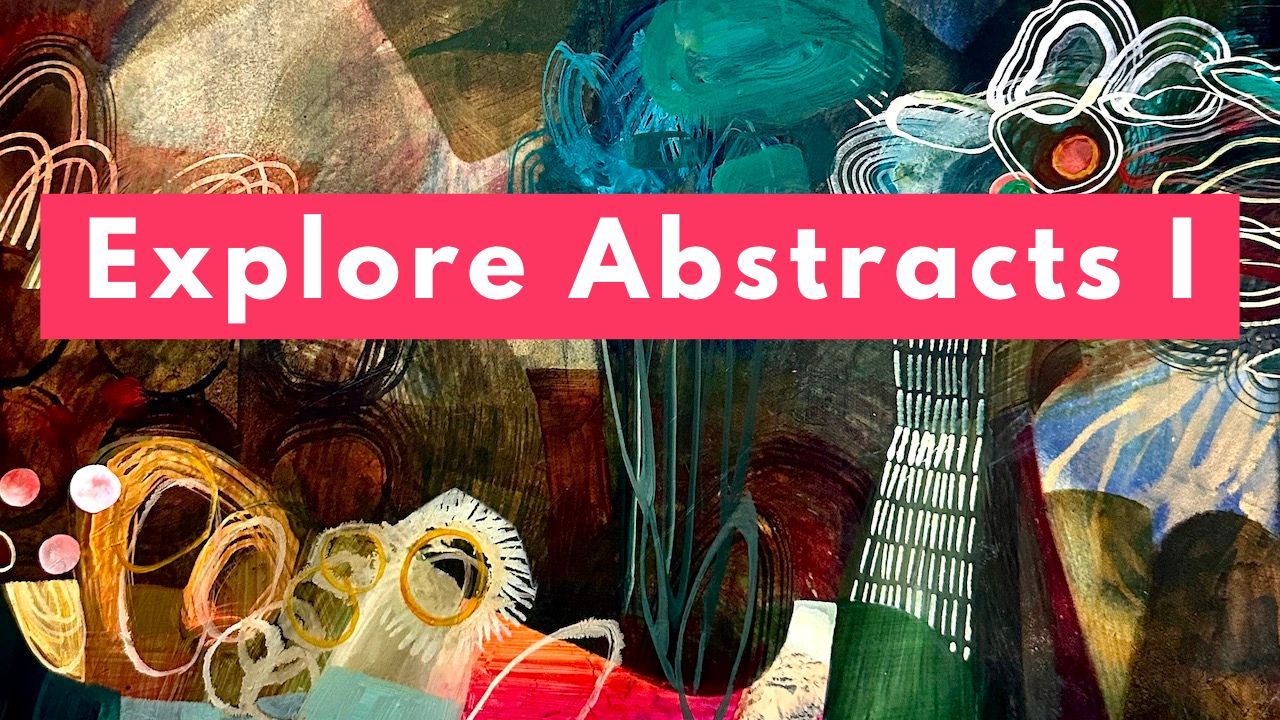
Explore Abstracts I
Are you yearning to break free from the conventional boundaries of representational art? Are you ready to explore abstract art in an organic yet structured way? You’re in the right place.
Explore Abstracts I is here and I’m so excited to tell you about it. Over the last three years I’ve been experimenting and exploring ideas, creative processes and techniques in acrylics and water-based media to bring you a new course focussed solely on abstract art.
A Packed Abstracts Course
With this course you will explore a broad selection of creative processes and ideas, and the shift away from representational art will lead you to discover new directions and artistic explorations.
Explore Abstracts I is a game changing course delivered in six modules originally released over a six week period. Each module has a specific theme and colour mood board and consists of five projects. These are delivered in bite sized portions structured to build on each other and to guide you along on a path of new discoveries. An abundance of techniques in acrylics and other media are linked to creative processes that are specific to each of the course’s modules.
Course Content
Abstract art is an art form unlike any other and I’ve created a comprehensive program covering the topics I enjoy:
- Diving deep into Colour mixing
- Acrylics used in new painting, printing and other application techniques
- Expressive mark making
- Developing a vocabulary of shapes, forms and textures by incorporating the Creative Leap ™ program
- Exploring options for composition
- Developing an interplay between discipline and playfulness
- Incorporating structure and openness
- Prioritising authentic artist development
- Strengthening creative connections
- Feedback is offered in an exclusive Facebook group for Explore Abstracts I
- This course is delivered daily during the course dates. Videos are pre-recorded and edited in a time efficient way in order to encourage momentum and focus.
Who's it for?
Explore Abstracts I is designed to cater to artists of all levels, whether you're a seasoned painter or just starting with your artistic endeavours. As is the case with all my online courses, you will have twelve months’ access to this course from date of registration to enable you to do the course live, at your own pace, or to revisit projects at a later time.
Materials List
There's a specific list of materials required for Explore Abstracts I.
Please see the list below and take note of the different kinds of acrylic paints and mediums to be used. Everything listed will be used during the course. Part of the value of Explore Abstracts I is using a variety of paints and mediums to obtain very different results.
Please read through the list thoroughly and click on the links in blue (these might be affiliate links for which I’ll receive a commission on purchases) to see items. In this course I use Golden Paints along with the same, high quality materials that I use in my daily art practice.
Paints
-
A Golden Fluid Mixing set. Note the Professional Golden Fluid set I used in previous courses has now been discontinued, and replaced by the Mixing set. It is widely available in the USA where it is manufactured.
-
ALTERNATIVELY you will need the three Golden Fluid primary colours: Red, Yellow and Phthalo Blue as well as White and Carbon Black. These can be substituted for another brand if necessary.
-
Together with the FLUID colours you’ll also require the following Golden HIGH FLOW paints (this paint is more like a concentrated ink and will be mixed with mediums to suit a variety of applications)
-
30ml (1oz) Golden Nickel Azo yellow High Flow
-
30ml (1oz) Golden Titanium White High Flow
-
30ml (1oz) Golden Indigo High Flow
-
30ml (1oz) Golden Magenta High Flow
-
30ml (1oz) Golden Sepia (or similar brown) High Flow
-
-
Golden Open paint 59ml tube transparent Red Oxide or other brown colour.
-
Golden Heavy Body 237ml 8fl oz tub of white titanium (not Zinc) acrylic paint.
-
Optional: White Gesso 236ml Any brand will work. This is required if you’ll use unprepared wooden panels (see below)
Mediums
-
Golden Matte Medium 237ml 8fl oz or larger container (NOT matte FLUID medium or OPEN medium)
-
Golden Heavy gel matte 237ml or larger container if you wish to explore further and work in many layers.
-
Golden Fine Pumice gel 237ml 8fl oz container depending on the size of your canvasses. This material is very important will be used as ground for painting and drawing on, as well as impasto techniques.
Paintbrushes
There’s a strong focus on use of colour and painting techniques in my courses. I use mostly short handle synthetic brushes suitable for acrylic painting, not too stiff (not hog hair) or too soft. Please note: sable or natural hair brushes normally used for watercolour should never be used with acrylics since the paint will destroy the hair because it binds to it. I’ll be using mostly Rosemary & Co and Silver Brush Limited brushes in the course as listed below
-
Dagger brush size 1/2” or 3/8”
-
Round pointed brush size 10 (medium)
-
Spiky comber brush 1”
-
Paddle or mottler brush
-
Thin, broad flat inexpensive nylon brush
-
Angled brush size 3/4”
-
I can also recommend Silver Brush Company’s brushes as alternative (their Silver Silk brushes are particularly suitable for acrylics). If you are based in Europe have a look at Borciani Bonazzi brushes as alternative
Drawing Materials & Surfaces
-
Three Derwent Inktense pencils in colours Ink Black, Deep Indigo and Antique White. Alternatively Caran’Dache Museum Aquarelle pencil in black, indigo and white.
-
Caran’Dache neocolour water soluble crayon in white and gold
-
Sketchbook - A4 or bigger suitable for mixed media
-
Black fine liner markers and pencils
-
Three large sheets of mixed media paper 250g or heavier, size A2 (around 17”x23”)
-
Ten wooden 12”x12” (30x30cm) paint panels, there are different options for these, from cheap to quite expensive. The cheaper ply wood panels work perfectly well, priming with white gesso will be required (I’ll demonstrate how this is done before the course starts).
-
You’ll only need gesso if you’re using unprimed wooden boards: Golden’s white Gesso 236ml, alternative brands will work as well.
-
For an even cheaper alternative, use mixed media paper prepared with gesso or acrylic paper.
-
Please note, the wooden boards are much easier to work on, and are ready to be framed without glass or gluing to a board first, for paper this will have to be done.
-
-
Four 16x16” (40x40cm) square wooden panels OR four 16x16” (40x40cm) or stretched canvasses (wooden surfaces are better suited for the techniques you will use in this course)
-
Canvas panels can be used as an alternative as well. If you choose this option, use canvas glued onto wood rather than canvas wrapped around cardboard.
-
-
Two additional stretched canvasses 20x20” (50x50cm) (NOT canvas board).
To recap, to paint on you will require some sheets of mixed media paper for experimental small paintings. You will then also work on ten 12”x12” boards. For three of the modules you will work on four 16”x16” boards or canvasses. For the final module you will use two 20x20” (50x50cm) canvasses, these need to be stretched canvasses, not on boards.
Other Items
-
A triangular long metal palette knife.
-
A disposable paper palette
-
Carbon copy paper
-
A few sheets of wet strength white acid free tissue paper or glassine paper or deli paper if you have.
-
Dough cutter for applying mediums to canvas see here and here
-
A sheet of fine grade sanding paper
-
A small pack of regular balloons
-
Small closable containers for mixed paint
-
Optional: Home printer it'll be useful to print out enlarged drawings and components that can be used for planning compositions and layouts